Turning around a battery compliance platform after the rules changed
My role
As Interim Head of Product, I owned the product strategy, the roadmap and delivery. I also worked directly with customers: I ran the discovery behind the new strategy and led all communication with them during the migration to the new platform.
My team
10 people: a Head of Engineering, a product manager, a designer, four engineers, two QA engineers and DevOps.
The problem
ReSource traces battery metals from the mine to the car, so that companies can prove where their cobalt, nickel and lithium come from. The product was built for the strict regulation that everyone expected at the time: blockchain, a digital twin of every bag of ore, heavy cryptography.
Then the industry turned towards deregulation. Key deadlines that required companies to act were pushed back, and interest in the platform dropped. My challenge was to rebuild the product for what the market needed now, without losing a single customer.
The idea
Shift the focus from traceability alone to accounting for materials that serves different compliance needs, from proof of origin to carbon footprint and recycled content. Instead of a rigid chain where every bag has to be scanned, a flexible system that works like a ledger: each company sees what material came in, what went out and how much of it has a proven origin.
We kept the core that worked and rebuilt everything around it, so the platform could grow with each new stage of EU regulation.
What we built
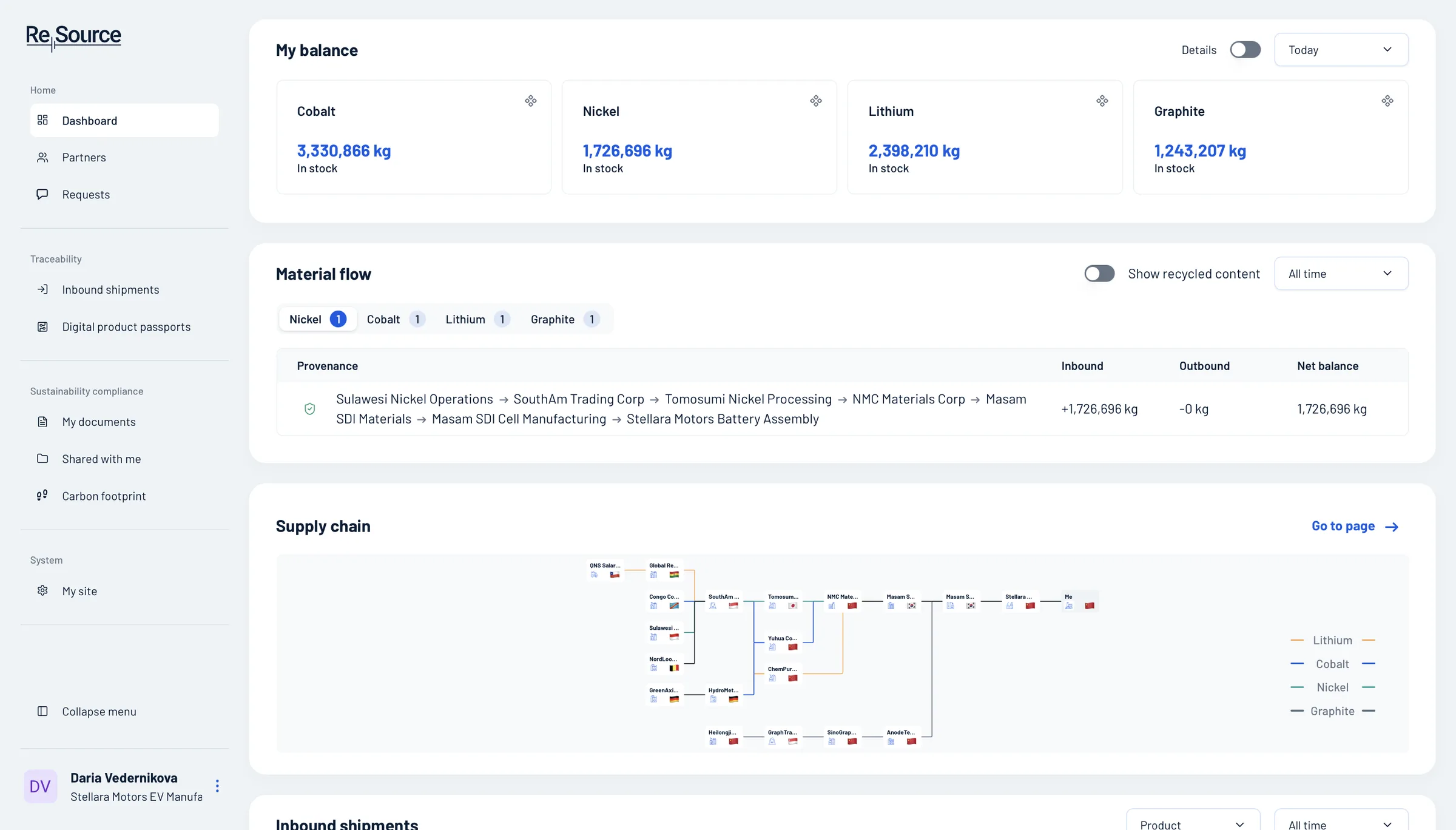
ReSource 2.0 serves the compliance, procurement and sustainability teams at every site in the battery chain, from the mine to the car maker. Each company manages its own shipments and shares only what its partners need to see.
A balance sheet for metal
The dashboard shows how much cobalt, nickel, lithium and graphite a site holds, where every kilogram came from and how much has already been promised to customers.
Proven, declared or missing
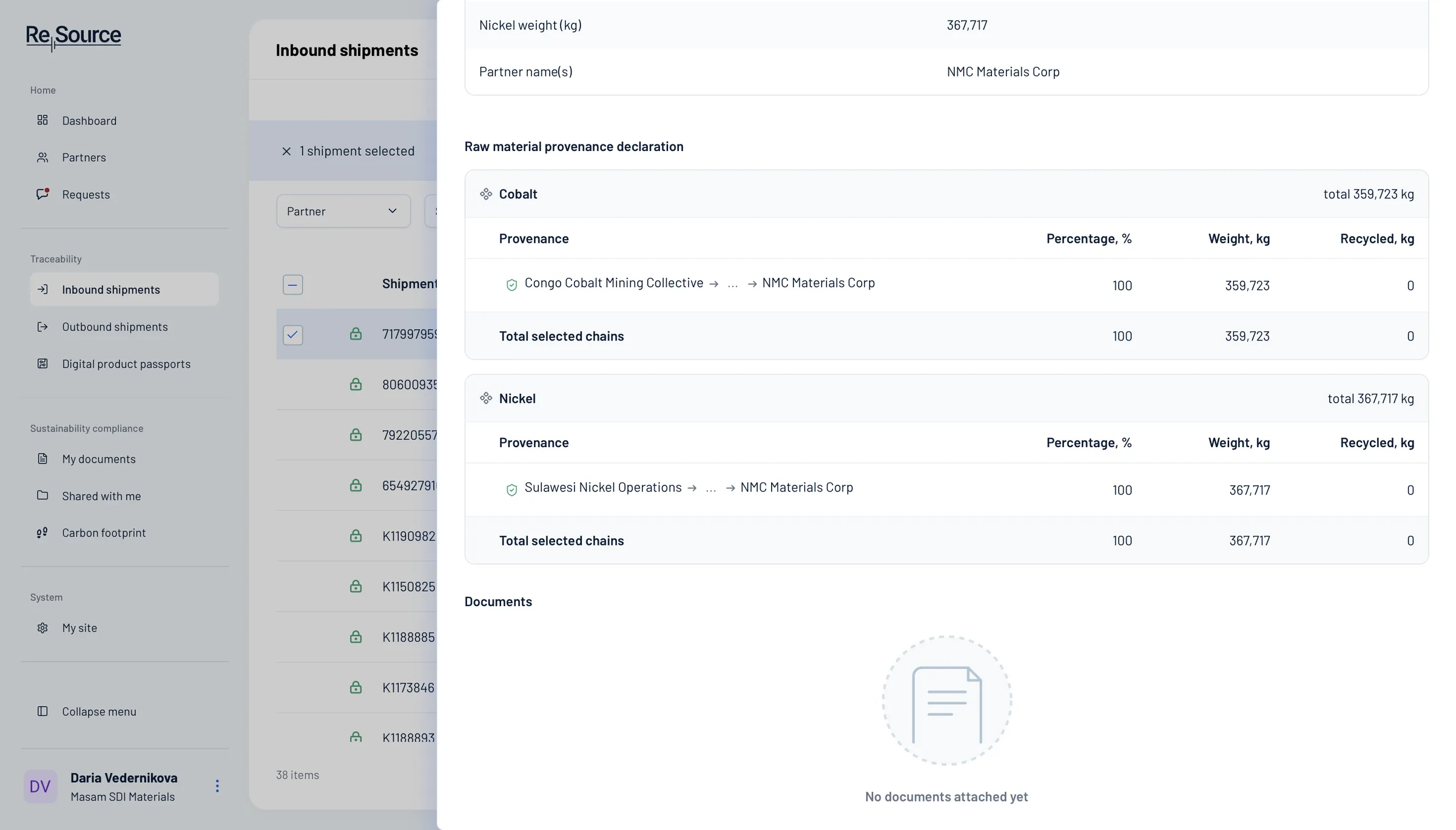
Every shipment shows the status of its origin. Provenance can be proven through partners on the platform, declared by the supplier or missing. A grey shield flags missing provenance, so the gap is visible before a customer or an auditor finds it.
The chain as a map
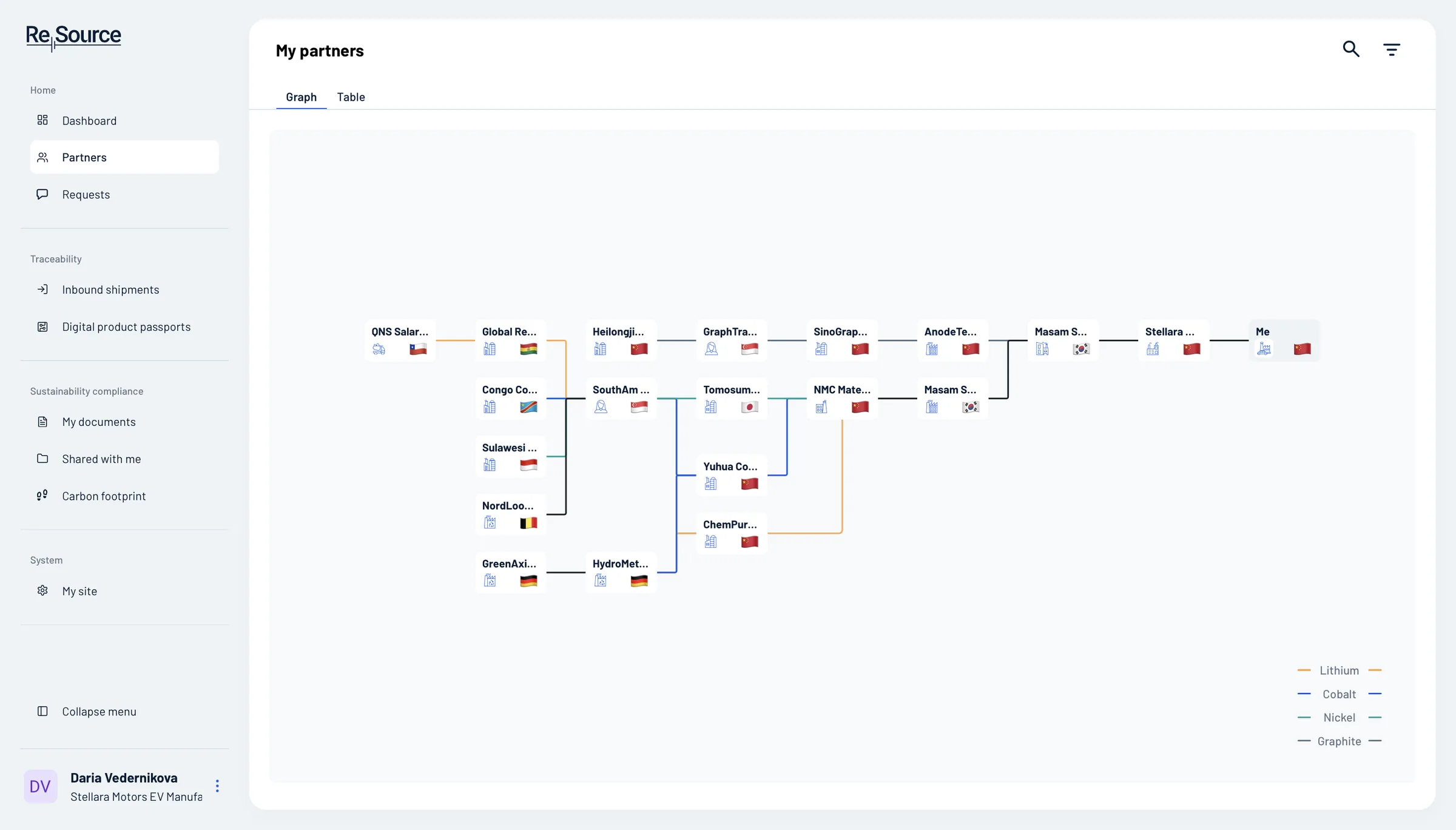
Partners matter here only as a route for material. The map shows how metal moves from the mine to the refiner to the cell maker, and a broken line shows where the chain loses its origin.
Documents with an audit trail
Certificates, reports and requests move between partners inside the platform. Every document has a validity period, every request is tied to a shipment, and the history stays for the auditor.
Ready for the next rules
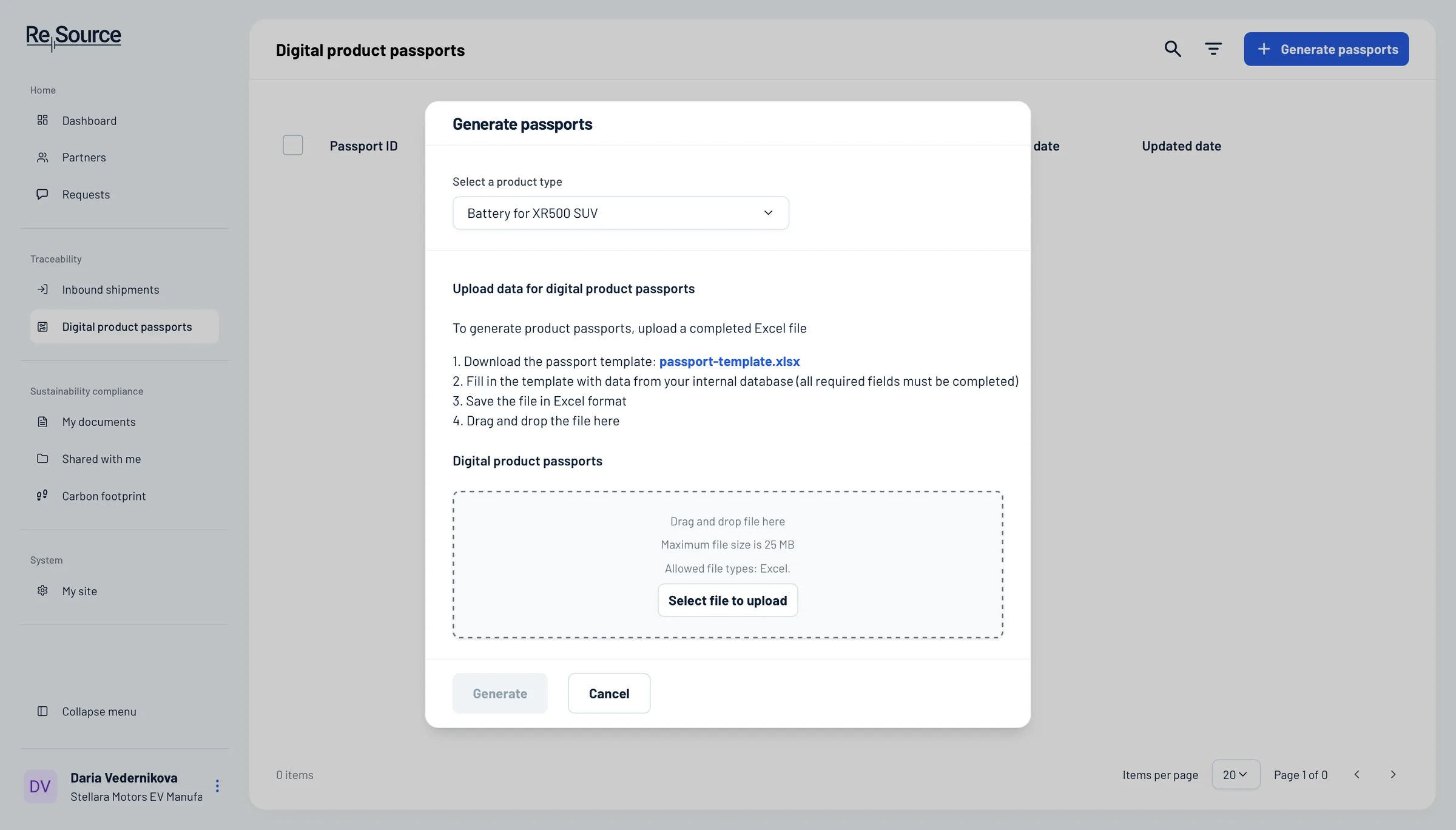
On top of this base we added battery passports and product carbon footprints, two requirements that the EU Battery Regulation brings in next.
Results
- 3x
- lower cost
of development - 6 months
- to rebuild
the core platform - 100%
- of enterprise customers
moved to the new platform
Takeouts
Working on ReSource taught us that a product built on a rule is only as strong as the rule. When the regulation moved, the platform lost its reason to exist overnight. What saved it was the everyday job underneath: keeping track of materials. Once the product served that job, regulation became one more use for it, not its only purpose.
We also learned that in B2B you sell to managers but build for the people who open the product every day. The decision to buy was made in a boardroom, but the decision to stay was made by the compliance and procurement teams who used it. We designed for them, and they carried the migration for us.
And we saw that a turnaround is not a fresh start. The fastest way forward was to keep the core that worked and rebuild everything around it. Customers trusted the new platform because it still held their history, and that is why none of them left.